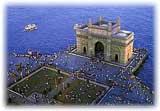
Built to commemorate the royal visit of King George V in 1911,
Gateway of India arch is made from honey-coloured basalt rock.
As a monument, it is both touching and slightly out-of-place.
The architecture is that of the 16th century Gujarati style, but
it neither succeeds as a convincinglyIndian monument nor as a
British relic. Ironically, the Gateway of India later served as
the exit for theBritish Raj. It was at this point that the British
regiment signalled before they left India on the 28th of February
1948.
Ten kms. north east of the Gateway are the four rock-cut temples on the island of Elephanta. It is said that the cutting of these temples commenced in 450 AD and lasted till 750 AD. It was originally called Gharapuri, but the Portuguese later changed the tongue-twisting name to Elephanta due to the presence of a large stone elephant at the entrance. In 1814, the elephant statue collapsed and was reconstructed in 1912 at the Victoria Gardens on the mainland. The caves are accessible by boat. The main cave has a number of large sculptured panels and a Shivalingam. Some of the panels include those of the Trimurti (the Hindu trilogy), the Ardhnarishwar (the half male-half female representation of Shiva), Lord Shiva doing the tandav, Parvati and her son Ganesha.
Built to commemorate the first visit of the Prince of Wales (later King George V) to India in 1905, this museum is located near Wellington Circle. Designed in the Indo-Saracenic style, it has sections for art, paintings, history and archaeology and a fine collection of miniature paintings, armoury, jade and porcelain.
Juhu Beach is located 18 km to the north of the city center in Mumbai. The famous beach is situated in the suburbs of Mumbai. To be more precise, Juhu beach is situated It is situated on the shores of Arabian Sea in Juhu suburb. Juhu beach in Mumbai lies in close proximity to several tourist attractions, including ISKCON temple, Mukteshwar Devalaya, Siddhi Vinayak Temple, Mahalaxmi Temple, St. Joseph's Church, and Holy Cross Church. Siddhi Vinayak Temple is one of the most famous temples in Mumbai. It is frequented by celebrities every now and then. The beach, which is a preferred shooting spot, is also located close to the residential homes of several film stars. It is a good idea to go for a day-long trip to explore the different tourist spots in and around Juhu Beach.
Mani Bhavan is a building where Mahatma Gandhi resided while on his trips to Bombay. Today it exhibits a permanent collection of pictures from his lifetime. It also houses the world's largest library on the Mahatma, with around 20,000 volumes of literature on the father of the nation.
Sir George Gilbert Scott designed the Bombay University in the French style. The university overlooks the Cross Maidan, one of the three open spaces or maidans which keep the center of Mumbai green - or atleast tawny. The high court is another impressive Victorian building with octagonal towers and Gothic turrets.
A number of interesting old buildings encircle the Horniman Circle. The Mint, built in 1824 on reclaimed land, has an old-world charm about it. The Town Hall houses a library of the Royal Asiatic Society. Columns for this neo-classical building were shipped from England. The Custom House is another old building here.
This prestigious art gallery is situated within the walls of the Prince of Wales museum has a long history of being the center of the art movement in Mumbai. Its cosy Samovar café, though little more than a narrow passageway, has long been the meeting place of creative artists.
Mumbai has Best & Largest Rail Network in India.
Its a Financial Capital.
Fashion Street to Buy Latest Designed Clothes.
Its Famous for Vadapav which you can get everywhere all over Mumbai
National Park at Borivali to Relax
Play Cricket, Foot ball and also a Great Green Cover at Five Gardens at Wadala
Amazing and Safe Night Life
Bollywood, Most Films Actors live in Mumbai.
Ganpati, Eid, Christmas Festivals etc are celebrated with Fan-fare
Juhu Beach, Gateway of India, Shivaji Park are Best Locations to Go during Weekends and Holidays

In This Section we have covered Tips section with cooking tips, health tips, educational tips, Photography Tips, Stain Removing tips, Computer Tips, Dandruff Removal tips for Better Life